
DNA Testing Services in Kenya – Accurate, Affordable & Reliable

DNA Testing needs not be an expensive, complicated, laborious, or time consuming affair. At KIBS, we provide reliable, accurate, timely, and affordable DNA tests.

We provide professional DNA testing services in Kenya including paternity tests, prenatal DNA testing (NIPT), baby gender tests, and genetic screening. Our Nairobi-based laboratory delivers accurate, fast, and confidential results trusted by families, hospitals, and legal institutions.

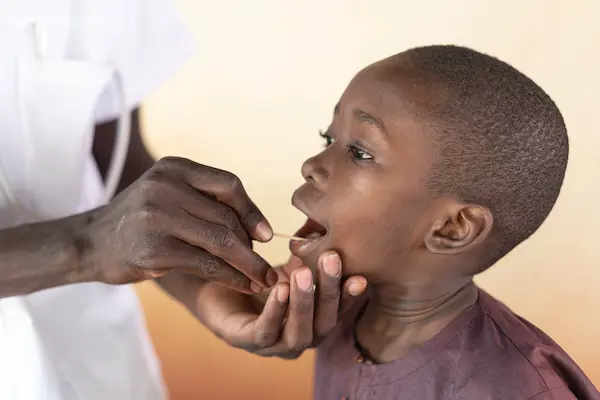
DNA paternity test sample collection in Kenya
DNA Paternity Test in kenya
Non-invasive prenatal DNA test in Kenya

NON-INVASIVE PRENATAL TEST (NIPT)

The Non-Invasive Prenatal Test (NIPT) is a blood test that is conducted in order to determine if the unborn baby has certain chromosomal and genetic conditions.

Genetic conditions tested include:

Down's Syndrome (Trisomy 21), Edward's Syndrome (Trisomy 18), and Patau's Syndrome (Trisomy 13).

Sex chromosome aneuploidies: Turner syndrome (Monosomy X), Triple X syndrome (Trisomy X), Klinefelter syndrome (XXY), Jacobs syndrome (XYY), and XXYY syndrome.

Microdeletions: DiGeorge syndrome (22q11.2), 1p36 deletion syndrome, Smith-Magenis syndrome (17p11.2), and Wolf-Hirschhorn syndrome (4p16.3).

100 monogenic disorders such as sickle cell disease, cystic fibrosis, hemophilia, fragile X, and many others.

The test is 100% safe to the mother and child and can be done from 10 weeks of pregnancy.

NIPT Test in Kenya

BABY GENDER TEST

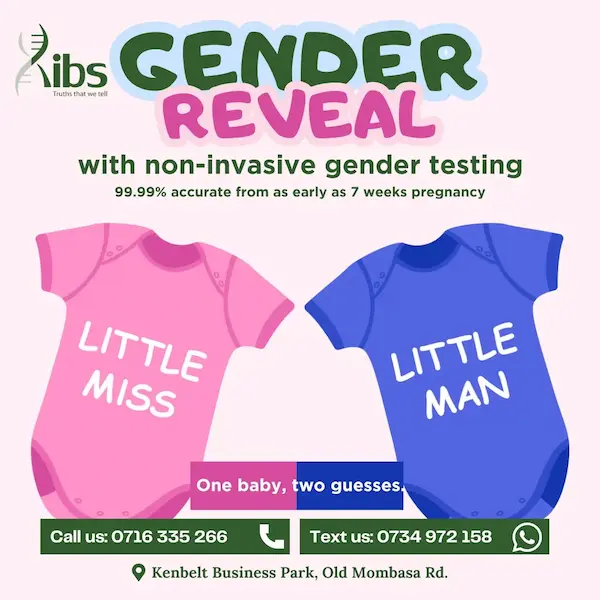
The Early baby Gender Test test is safe, non-invasive, and reliable, making it an excellent option for parents who wish to learn their baby’s gender earlier than is typically possible with ultrasound.

The DNA gender test determines the sex of the unborn child. It can be conducted from week seven of pregnancy. Only a sample of the mother’s blood is needed. This means that the mother doesn’t have to wait until the pregnancy is 20 weeks to determine her baby’s gender through ultrasound. It is more rleiable and accurate than ultrasound.

Baby Gender DNA test
Early Gender Reveal Test
SRY Gender Test

SRY Gender Test

The SRY gender test is fast, accurate, and scientifically validated, providing a dependable method for gender verification when required.

The SRY Gender Test is a DNA-based test used to determine biological sex by detecting the presence of the SRY gene (Sex-determining Region Y) located on the Y chromosome. This gene plays a key role in male development. If the SRY gene is detected in a DNA sample, the individual is genetically male; if it is absent, the individual is genetically female. The test is performed using a simple DNA sample, such as a cheek swab or blood sample, and provides highly accurate results. Because it analyzes genetic material directly, the SRY gender test is a reliable method for confirming biological sex. This test is commonly used in sports and competitive athletics, particularly in disciplines such as boxing, athletics, and other regulated competitions, where verification of biological sex may be required for eligibility in male or female categories. It can also be used for medical, research, or identity verification purposes where confirmation of genetic sex is necessary.

SRY Gender Test
NEWBORN SCREENING

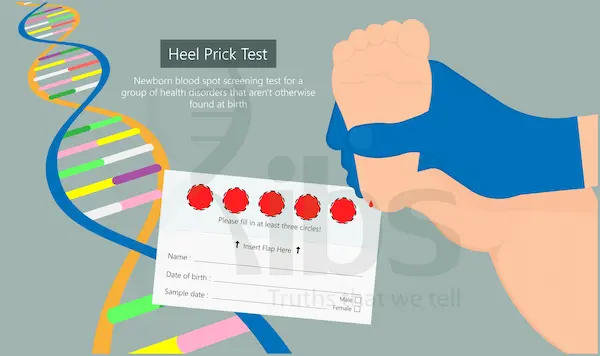
Newborn screening is a simple and important test performed shortly after birth to identify certain genetic, metabolic, and hormonal conditions that may not be visible at birth but can affect a baby’s health if left untreated. Early detection allows doctors to start treatment promptly, helping prevent serious complications and supporting healthy growth and development.

The newborn screening test provides parents and healthcare providers with peace of mind and an early opportunity to protect a child’s long-term health through timely diagnosis and treatment.

Newborn screening test sample collection in Kenya
Newborn Screening Test
inherited disease screening

CARRIER SCREENING

By identifying carrier status early, couples can make informed reproductive decisions and discuss available options with healthcare providers.

The Carrier screening genetic test determines whether an individual carries genes associated with conditions such as cystic fibrosis, sickle cell disease, and other inherited disorders that could be passed on to their children. People who carry these mutations are typically healthy and show no symptoms, but if both parents carry the same genetic mutation, there is a chance their child could inherit a genetic disorder. Carrier screening is ideal for individuals or couples who are planning a pregnancy or are already pregnant, helping them understand their risk of passing on specific genetic conditions.

Carrier Screening Test

KARYOTYPE TEST

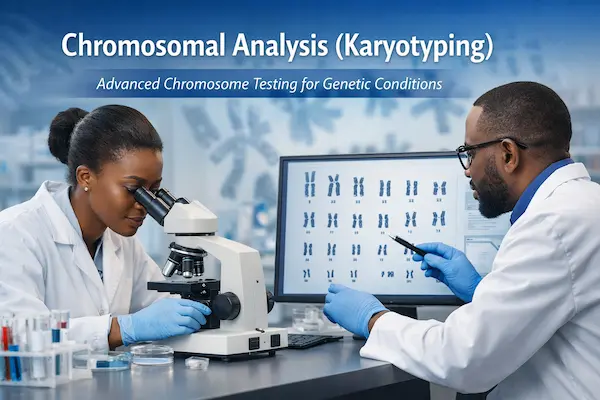
The karyotye test looks at your chromosomes to check if they are normal in number and structure and is used to investigate infertility, repeated miscarriages,and identify conditions such as Downs Syndrome.

In this test, cells are collected, grown in the lab, and examined under a microscope so the chromosomes can be clearly seen and arranged in pairs. Karyotyping is commonly used to detect conditions such as Down syndrome, Turner syndrome, and Klinefelter syndrome. It is also helpful in investigating infertility, repeated miscarriages, and some types of cancer, especially blood cancers. During pregnancy, it can be used to check the baby for chromosomal abnormalities. While karyotyping is a reliable and widely used test in genetic diagnosis and healthcare.

Karyotype Test in Kenya
Karyotype Test
SRY Gender Test

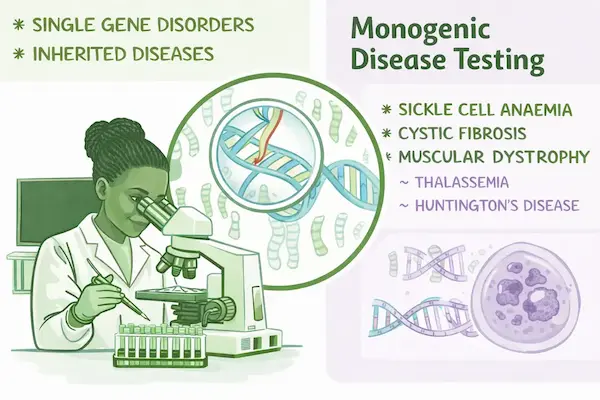
MONOGENIC DISORDERS TEST

Monogenic disorder test identifies genetic changes on single genes that cause diseases such as sickle cell anaemia, cystic fibrosis, and Huntington’s disease.

Monogenic disorder testing is a genetic test that looks for changes in a single gene that can cause an inherited condition. These conditions are passed down from parents to children and include diseases such as sickle cell anaemia, cystic fibrosis, and Huntington’s disease. The test works by examining your DNA to identify specific gene changes that may explain symptoms or show your risk of developing a condition. This type of testing is useful for diagnosing health conditions, confirming a suspected genetic disorder, or checking if someone is a carrier who can pass the condition to their children. It can also help guide treatment and family planning decisions. The test usually requires a simple sample, such as blood or saliva. Results are carefully analyzed by specialists to ensure accuracy. Monogenic disorder testing provides clear and focused answers, making it an important tool in modern genetic healthcare.

Monogenic Disorder Test
SRY Gender Test

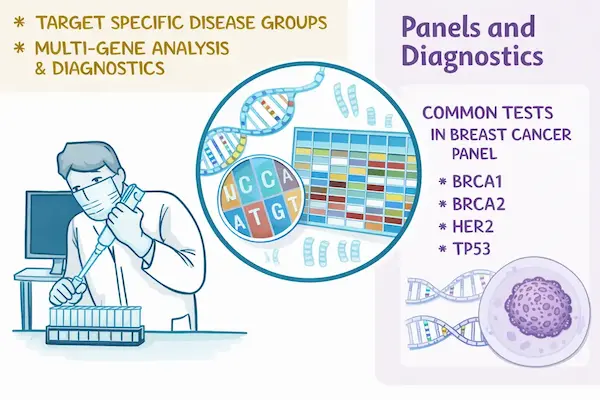
Panel Tests

Panel tests are genetic tests that check a group of related genes at the same time to look for changes linked to a specific condition such as breast cancer.

Instead of testing one gene at a time, these tests analyze many genes together, making the process faster and more efficient. They are commonly used for conditions like inherited cancers, heart diseases, and other genetic disorders where multiple genes may be involved. These tests help doctors identify the cause of symptoms, confirm a diagnosis, or assess a person’s risk of developing certain diseases. Panel tests can also guide treatment decisions and help families understand inherited risks. The test usually requires a simple sample, such as blood or saliva. Results are reviewed by specialists to ensure they are accurate and meaningful. Panel diagnostic testing provides a comprehensive and practical approach to genetic testing, helping patients get clear answers more quickly.

Genetic Panel Test

Accurate

99.999% Accuracy. Conclusive results based on 24- and 44- marker tests.

Inexpensive

DNA testing fees start from as little as 10,000 kshs per person.

Fast

Results are typically out in 5 working days.

Discreet & Confidential

Every effort is made to protect your privacy and confidentiality.
WhatsApp Chat with a Lab Specialist